Other than India’s many festivals, I love the fact that people are ready to let others explore their traditions, cultures and uniqueness in how these festivals are celebrated. If you have been following this blog, you know that Onam just went by. Like last year, I had beautiful Pookalams adorn this blog. Ten floral carpets – one for each day, leading up to the tenth day of Onam. The flowers had a calming effect on me every day and now that they are on the blog, I can look at them whenever I want.
Onam was a festival that I discovered last year. Not that I hadn’t heard of the festival before but then unless people around talk about specifics of a festival that they celebrate, it’s hard to know things that are done within the four walls.
Last year, my friend LP shared with me a lot about Pookalams and what it means for Onam, how she celebrates this festival and does it the most traditional way possible so that her 11 year-old can get a flavor of his roots. Excited as I can get, this year too I posted Pookalam pictures from her house and everybody just loved them. One question that many people asked me was about Onam Sadhya.
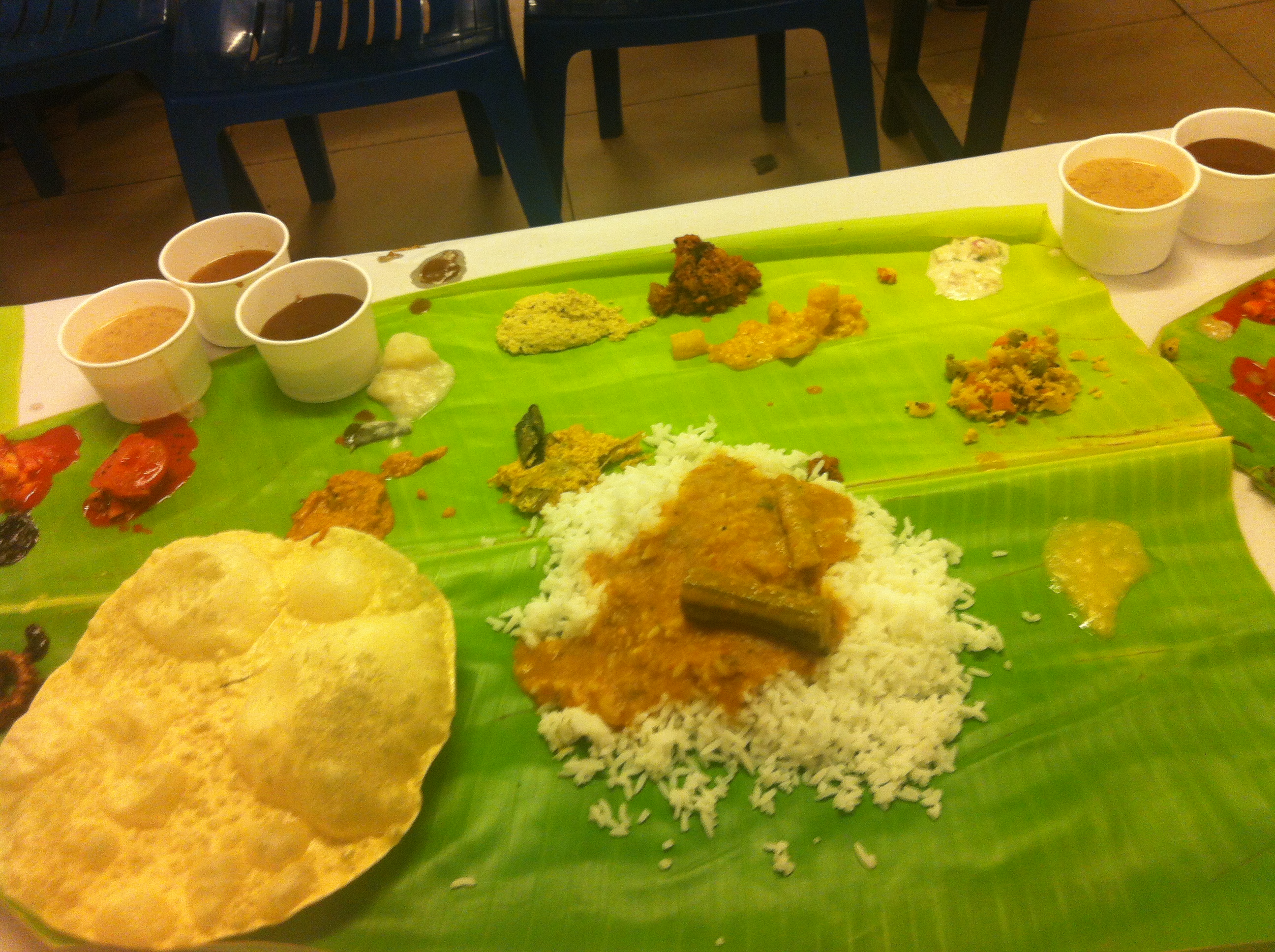
Onam Sadhya is the Onam feast – the traditional Onam meal. Lucky as I could get, LP invited VT and me over for Onam Sadhya yesterday. I did not even think twice to say yes when she asked us. My level of excitement was way above the usual one. I will let the pictures do the talking but the many things that I learnt yesterday from this awesome Sadhya go as below:
- Onam Sadhya is typically a lunch feast.
- It consists of vegetarian food but in North Kerala, non-vegetarian food could also be included.
- Men prepare all the food for Onam Sadhya and they serve too.
- People sit and eat together in batches.
- The food is served on Plantain leaf and you will have to ask for a spoon if you really want it. VT did that!
- You can eat as much as you want and there is no limit to the number of servings. Men walk by with vessels in their hands and will ask you to take the food if you want. VT and I took 6 helpings of pineapple pachadi. It was so yum.
- The water was rose colored but not sweet. It had some extraction of a tree bark and some herbs to increase appetite and digestion.
- There can be as many as 64 items for the meal. Ours had around 27.
- Most of the dishes served have coconut as an ingredient.
- The pickle goes on top left corner, the papad on the bottom left, rice in the middle and various vegetables, chutney and pachadi on the top.
- Left middle is meant for banana chips salted and those coated with jaggery, and fried bitter gourd. They add the necessary crisp to the meal.
- The chutneys are coconut and the one with jaggery and ginger.
- The rice is meant to be eaten with sambhar, rasam and curd. It is so light that you can eat a lot more than you would have at home.
- There are three kinds of payasam – banana, dal and milk. I loved the milk and the dal one. My no-desserts for 21-days challenge went for a toss.
- You fold the leaf from the bottom to top to indicate that you are done and satisfies with the meal.
- Betel leaves with lime is given to cleanse the palate and enhance digestion. VT and I shared one!

This one is for sure a lunch I am going to talk all my life. The firsts are always special and when you get back home to doze off for two hours, you know you had a great meal.
Not just that, I am already thinking of next year and my plan to is skip breakfast for next year’s Sadhya so that I can eat more! 🙂
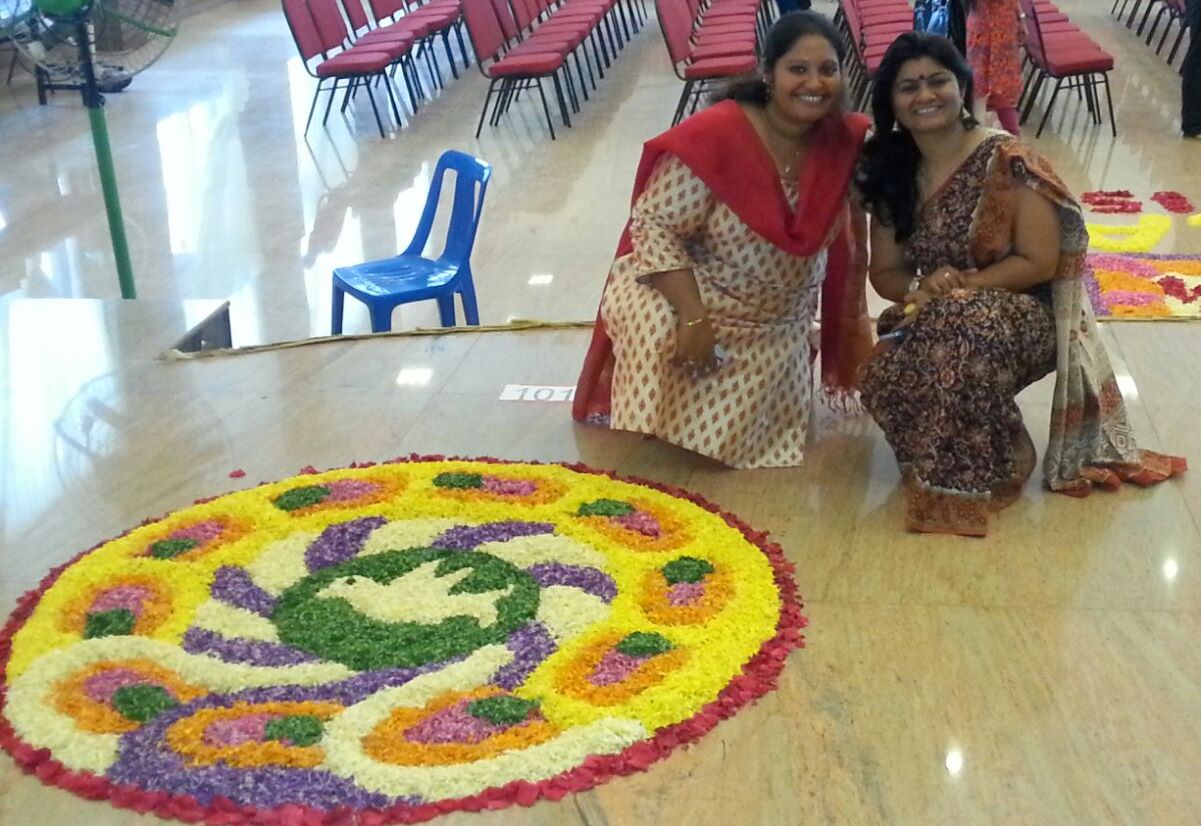
 happiness and food
Speechless 😀
LikeLiked by 1 person
Looking at the many comments – I am speechless now 🙂
LikeLike
And I’m do happy for you…. food gets everyone talking 😄
LikeLiked by 1 person
Oh yes! Totally 🙂
LikeLike
Delicious! That picture is lovely. Keep smiling. 🙂
LikeLiked by 1 person
Thanks Payal! 🙂
LikeLike
Thank you for sharing your experience – this holiday is totally foreign to me, so I appreciate the opportunity to learn a bit more about it! Glad you enjoyed your celebrations. 🙂
LikeLiked by 1 person
Yes, we did! We come from the North of India and were pretty new to this – so great chance to experience. Thanks for stopping by!
LikeLiked by 1 person
Yummy food! The picture reminds me of a Parsi wedding food. Although, it will be more non-vegetarian than veggies. Glad that you enjoyed the feast.
LikeLiked by 1 person
Ah! Non-veg food will be awesome too. Langars also resemble this. Just that the variety is much more here. 🙂 Thank you!
LikeLiked by 1 person
You can browse for Parsi lagan nu bhonu
LikeLiked by 1 person
Cool! Will do that 🙂
LikeLike
This sounds like a wonderful feast. As someone who loves vegetarian food, although I’m not a vegetarian myself, I think this is a great tradition. I happen to also love coconut!
LikeLiked by 1 person
That I agree. Great tradition 🙂 Coconut is abundant in this part of India. 🙂
LikeLike
Oooh I need to make sure your friend LP invites me too next time.. so much foood … He he he he yummmy. ..
LikeLiked by 1 person
You come from UK, we will get you going 😀 Thank you!
LikeLiked by 1 person
really .. right let me book my ticketsssssssssssssssssssssss …
you see for foood i can go anywhere 🙂 he he he he
LikeLiked by 1 person
ha ha! lol!
LikeLike
I love eating on Plantain leaf… In Bengali households whenever there is pooja, we usually serve food on plantain leaf and there also men mostly serve the food…Reading this makes me realize that we are all similar in more ways than one… Our office had Onam Sadhya in one of the counters last year and we enjoyed that thoroughly! So I can imagine what your experience might have been 🙂
LikeLike
Wow! Really? I did not know that Bengali households also serve food on plantain leaf. I thought it’s just the south. But then look at langars – cooked by men, served by men, unlimited food and feed the hungry sort of concept. You are right – all the traditions are similar in many ways that we can think of. 🙂 Thanks for stopping by!
LikeLike
Good that you did 10 pookkalams. 🙂 I saw the post with all 10 earlier, and they looked really beautiful.
on Onam Sadhya —
1. Pineapple pachidi rocks. It’s my favorite. My dad makes an amazing pachidi.
2. We have that rose colored water on other days too. If you want to try, it’s called Dahashamani. You get in Kotakkyal Arya Vaidya Shala pharmacy.
😀
Onam is absolutely delightful at our household too. as is Vishu. and eating on plantain leaf is lovely. I think how it is folded varies per the region. At times, we’re said to fold top to bottom. 🙂
LikeLike
Omg! That pharmacy’s name is mouthful. But I will look it up! 😀
Vishu is also a Malayali festival, right? That trick on folding – never knew that! Thanks for sharing!
LikeLike
Its funny to read you describing things in English I’ve known all my life in mothertongue 😀
😦 I missed sadya this year, sacrilege in my books 😥
LikeLike
Awww!! Hugs dear!
I know – I don’t know the Malyalam names – just pineapple pachadi 😀
LikeLike
Food on banana leaf! Miss a lot.
LikeLike
You should have it asap! 😀
LikeLike
Mmmm…you got my mouth watering, Parul! Sadly most of my Keralite friends are online 😛
LikeLike
Ha ha! Now is the time to ask more questions and get them to treat you 😉
LikeLike
Yummy…I want rice and sambhar right now. (I would probably have asked for a spoon too) 😉
LikeLiked by 1 person
Lol! I am good with hands all the time except when I am supposed to use a spoon 😀 But VT needs a spoon all the time! 😉
LikeLike
I love pookolams. I think next Onam I will make one at my home too. Good detailed description of all the mouth-watering dishes 🙂
LikeLiked by 1 person
You should do that Beloo and share pictures. It will be great. Thank you for stopping by!
LikeLiked by 1 person
I have only seen delicious pics of Onam Sadhya … Probably I will experience it one day in real… pookalam looks so pretty 😀
LikeLiked by 1 person
There will be a day! Stay hopeful 🙂
LikeLike
Nice to know about this traditional way in which the festival is celebrated. Eating in plantain leaves has a charm of its own and is popular in coastal areas. You know eating with hand has a logic of its own, wherein each finger has a specific role, I have outgrown that habit though.Keep sharing such culture and festival specific posts as it is good to know about different cultural traditions.
LikeLiked by 1 person
I still eat rice with hands. I could never leave that habit. Thank you for sharing your little personal story 🙂
LikeLiked by 1 person
Best part is men cook and serve. Some respite from kitchen is always welcome. Wish I can get such an invite from my Malyali friends.
LikeLiked by 1 person
Ha ha! I agree. Let you r Malyali friends know that you want to try out this food 🙂 😀
LikeLike
Lovely blog 🙂 Keep doing the good work!
LikeLiked by 1 person
Thank you Mansi!! Glad you liked the post.
LikeLiked by 1 person
Thank you Mansi! Glad you liked the post!
LikeLiked by 1 person
Hey this is so awesome! Makes me miss home all the more 😦
We eat on banana leaves too on festivals..could never get my hands on them when in London, here in Singapore though thankfully they are available..but even then, nothing comes close to the experiences back home!
LikeLiked by 1 person
Aww!! hugs.
Thanks Leena for sharing your personal little moment!
LikeLike
Aww!! I agree to that. Nothing comes close to the experience back home. But you can always come home 🙂 thanks for stopping by!!
LikeLike
In U.p. also whenever there is any ritual food is not served in plates . There are pattals . Dry leaves of some big tree put together in a shape of thali . Types of vegetables , pumpkin is must , , rice , pulse of gram , papad , poori , kachodi , and kheer . Onion and garlic is not used even then food tastes delicious . More or less every where traditions are same .
LikeLiked by 1 person
Yeah – almost the same. I had totally forgotten about the pattal.
LikeLike
North Keralite raising her hand here 😀 Yup, we usually have nonveg with the sadhya, though of late, I’ve noticed more people even from North Kerala are leaning towards the traditional sadhya. Guess they’re becoming health conscious (well, three payasams, so maybe not). My favourite payasam is the milk one too. I like the banana one sometimes, if it’s not too sweet.
LikeLiked by 1 person
I would love to have non-veg Sadhya too! Won’t it be such a delight? 🙂
I liked the dal one more than the banana. The banana was a taste that I guess needs to develop over time. Thanks Sreesha!
LikeLiked by 1 person
It is! There’s fried chicken or fried fish, usually served with a spicy fish curry. Yum! *drools*
LikeLiked by 1 person
Aiyoo!! I am drooling 🙂
LikeLiked by 1 person
I daresay you’d explained it better than a Mallu (read : me) could have explained 🙂
LikeLiked by 1 person
Lol! Really? Thank you! 😀
LikeLike
Interesting post. Was not aware of all these insights about Onam Sadhya. Hope I get to eat one, once in this life time. Your pics are tempting me to pick the food right off the laptop screen despite having dinner some time ago!
LikeLiked by 1 person
Ha ha! Glad you enjoyed the read. Catch your friends from Kerala and make them get you to Onam Sadhya. It’s fabulous 🙂
LikeLike
Such detailed explaination of the fest and feast Parul. Hat’s Off to you. Yes, men in the family do cook during Onam – a good observation there. One of my fav memories of childhood is seeing dad and mm busy in the kitchen when I wake up on Onam morning. Thank you for taking me back. Lots of love!
LikeLiked by 1 person
Glad you felt that way. 🙂 Thank you Nisha!
LikeLike
HI PArul – Am glad that you loved the Sadhya. I am a Keralite and I take pride of being so. Onam is a celebration, which the entire citizens celebrate in kerala, irrespective, of caste and gender.
LikeLiked by 1 person
Yes Ajay. I learnt about Onam last year and LP, my friend shares a lot about the festival. I am learning 🙂
LikeLiked by 1 person
the description was awesome and you made me literally laugh by stating that you dozed off for two hours post the lunch. I wonder how much you have eaten 😛 heheheh
LikeLiked by 1 person
Ha ha! Weekends are to eat and sleep. Right? 😉
LikeLiked by 1 person
You just reminded me of onam pasts and posts.. people in kerala usually drink their water boiled, and when they boil they add herbs, and barks.. so you can catch the water coloured as brown and pink, at times yellow/light green.. courtesy the jeera/cumin seeds.. like Vinay said, the folding may vary from parts, but what it means is the food if anything is left should not fall on your lap.. so top to bottom works many times with the water glass on top of it that it does not open.. thanks for the nostalgia, Parul 🙂 I
LikeLike
oh the ginger-jaggery chutney is calle inji puli and that’s my fav part of the meal.. plus the payasam made in jaggery juice – could be dal/wheat/banana.. or any such
LikeLike
Inji Puli! LP told me but I forgot all names. Like everything was so hard and tongue twister 😉
LikeLike
Thank you so much for adding on. Yes, this water was Rose pink but not at all sweet and must have been boiled. I like that logic of folding the leaf. makes so much sense. Thank you for adding and I feel happy that this post could bring back some memories from the past.
LikeLike
Ahhh the lovely Onam Sadhya. Delicious! 😀
By the way didn’t know the point about men preparing all the food for this. Now that’s an eye opener ;).
LikeLiked by 1 person
Yeah – they cook and serve. It’s cool 🙂 The food Aseem was yum. I can have that any time of the day.
LikeLiked by 1 person
This was at ECA wasn’t it?
Being a mallu I spent Onam at my mom’s place and she had a spread prepared for L and I. We were so full by the time we finished. Let me know when you feel like some mallu food. I’m a pretty good cook and stay close by 😀
LikeLiked by 1 person
Yes, this was ECA. Thank you much. That means so much. I loved the food and it was so light as well. We get to eat the traditional food so less that any opportunity is fabulous 🙂
LikeLike
The blog recounts the author’s experience of attending an onam sadhya near me, a traditional Kerala feast served on a banana leaf, which includes a variety of vegetarian dishes. The author shares how the meal, prepared and served by men, consists of up to 64 items, with dishes like pineapple pachadi, sambhar, and different kinds of payasam. The meal concludes with folding the banana leaf and chewing betel leaves for digestion, leaving the author eager for next year’s celebration.
LikeLike